

|

Erhu
|
Erhu
is a kind of violin (fiddle) with two strings which, together with
zhonghu, gaohu, sihu, etc, belongs to the "huqin"family.
It is said that its origin would be dated up to the Tang dynasty (618-907)
and related to the instrument, calledxiqin originated from a Mongolian
tribe Xi. During Song dynasty (960-1279), the second generation of
the huqin was among the instruments played at the imperial banquets.
During the Dynasties of Ming (1368-1644) and Qing (1644-1911), the
erhu underwent a great development at the time of the golden age of
the local operas. The erhu then developed in a different "schools".
Two famous artists Hua Yanjun (1893-1950) and Liu Tianhua (1895-1932)
made an exceptional contribution to the improvement of the erhu, and
it was indeed due to the latter that the erhu, an instrument mainly
for accompaniment in an opera, becomes a solo instrument. After the
foundation of People's Republic of China (1949), the manufacture of
the erhu, the playing techniques, the repertoire as well as the musical
education of this instrument have undergone a rapid development. The
repertoire has grown rapidly in the genres of solo, with ensemble
as well as concerti with symphony orchestra.
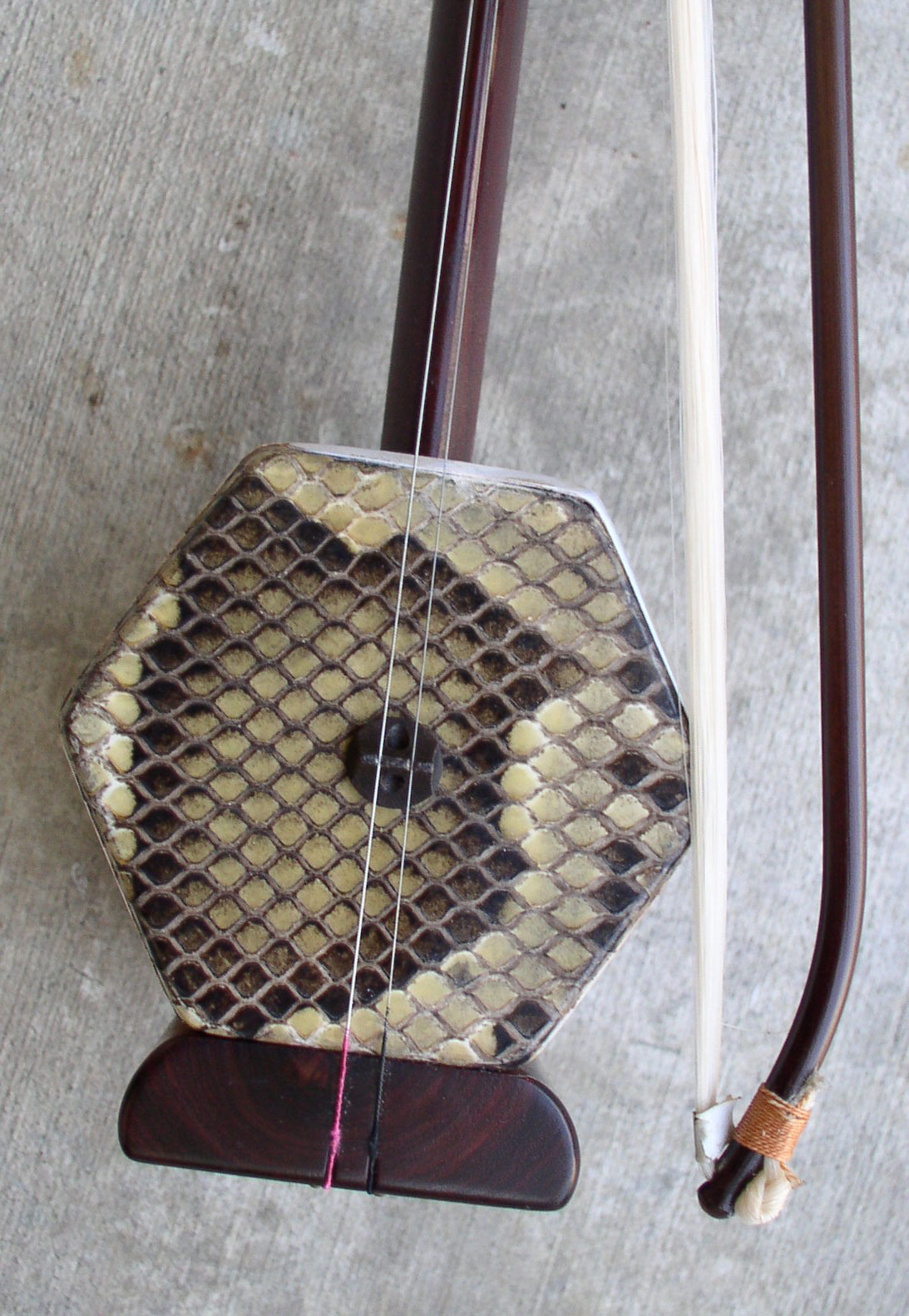
The sound body of the erhu is a drum-like little
case usually made of ebony or sandalwood and snake skins. It usually
has a hexagonal shape with the length of approximately 13 cm. The
front opening is covered with skin of python (snake) and that of the
back is left open. The functions of this case of resonance are to
amplify the vibrations of the strings. The neck of the erhu is about
81 cm long and is manufactured with the same materials as the drum.
The top of the stem is bent for decoration. The two tuning handles
(pegs) are found close to the end of the stem. There is no frets (as
contrast to the lute) or touching board (as contrast to violin). The
player creates different pitches by touching the strings at various
positions along the neck of the instrument. The strings are usually
made of silk or nylon. Nowadays, metal strings are commonly used.
The bow is 76 cm long and is manufactured of reed which one curves
during cooking, and arched with horse hair in the same way as the
bow of violin. However, in the case of erhu, the horse hair runs between
the two strings. In another word, one cannot take off the bow from
the instrument unless one of the two strings is taken off or broken.
The posture which the player must adopt to play
the erhu is the same as that adopted for the other kinds of huqin:
the left hand holding the fiddle and the right hand, the bow. The
erhu is put on the lap vertically, the left hand moves vertically
to touch the strings for the right pitch while the left hand (with
the bow) move horizontally to make the sound. occasionally some musicians
hold the instrument with the help of a rope, in the same way as for
saxophone, in order to play standing or walking. However it is quite
awkward to play and it doesn't look elegant with the sound body pressing
against the belly and the stem of the instrument pointing outward.
Therefore, the musicians normally play sitted unless it's absolutely
necessary.
The erhu sounds similar to human voice, and can
imitate many natural sounds such as birds and horse. It is a very
expressive instrument, most well-known for playing melancholic tune,
but also capable of play merry melody. Click to listen to a sample
of erhu music.
The erhu often plays an important role in the national orchestras.
In the smaller orchestras, there are usually 2 to 6 erhu, in largest,
l0 with 12. In fact, the erhu plays the same role as the violin in
the Western orchestras. |

Guqin
|
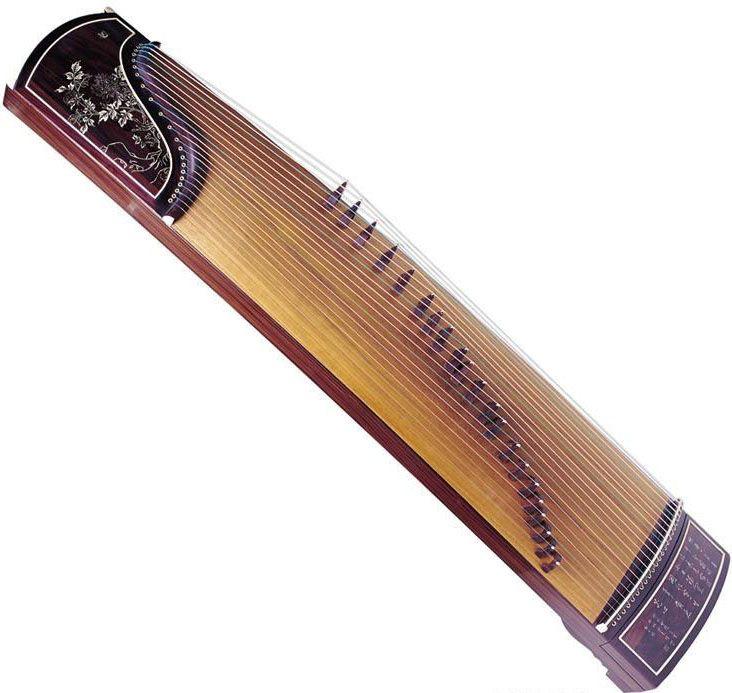
The
guqin, a seven-stringed zither, is China's oldest stringed instrument,
with a
history of some 3000 years. Chinese music has a long history, and
its essence
is best expressed on the guqin. In Imperial China, a well educated
scholar was expected to be skilled in four arts: Qin (the guqin)
Qi (the game of Go) Shu (calligraphy) Hua (painting). Historically,
the guqin has been viewed as a symbol of Chinese high culture and
the instrument most expressive of the essence of Chinese music.
There are over 150 guqin handbooks extant, which contain more than
3,000 pieces of music as well as essays on the theoretical aspects
of the guqin and its music.
The guqin has its own notation, which itself has a history of at
least 1500 years.
In Chinese, "gu" means old and “qin” means
"musical instrument". Historically, guqin was rendered
as "qin" in most ancient texts. Because its long history,
it has during the last 100 years been widely called guqin. There
is much symbolism surrounding the instrument. For example, it measures
3' 6.5" (Chinese feet and inches), symbolizing the 365 days
of the year; the upper surface is rounded, representing the sky,
the bottom flat, epresenting the earth. The five strings of the
earliest qin symbolize the five elements: Metal, Wood, Water, Fire
and Earth. When Bo Yikao, son of King Wen, first ruler of the Zhou
Dynasty around the 11th century BC, died the Emperor added a sixth
string to mourn his son; the sound of the sixth string is sorrowful.
The seventh string was added by the second Zhou ruler, King Wu to
inspire his soldiers when his country went to war; the sound of
this
string is very strong. Finally, the 13 mother-of-pearl inlays along
the outer edge represent the 13 months of the lunar year. Undoubtedly,
the guqin is a part of our world's heritage, but today fewer than
two thousand people can play it, and it is rarely seen in China.
Music that was written over a period of many centuries is unknown
to most people. Program Notes Yi Gu Ren (Thinking of an Old Friend)
This piece, also known as Kongshan Yi Guren (In the Mountains, Thinking
of an Old Friend) first appeared in the Dihui Guan Qin Handbook
of the Qing Dynasty. This handbook was popular in Sichuan. This
piece is considered a masterpiece of the Wu school. It became popular
throughout China after its publication by Peng Zhiqing in the Jinyu
Qinkan in 1937. Peng learned it from his father. It is based on
the story of Dai Kui's journey to visit his friend Wang Xianzhi
during the Eastern Jin dynasty (317-420 AD). Although his friend
was not at home, Dai Kui was satisfied that he had made the effort.
The subtle melody reflects the restrained emotions of a Confucian
scholar. Ping Sha Luo Yan
(Wild geese descending on the sandy beach) This piece is more than
300 years old. As the title suggests, the music depicts wild geese
descending and ascending on a bright sunny day. The melody also
symbolizes the abstract concept of tranquility, which has been
pursued by Chinese scholars through the ages. You Lan (The Solitary
Orchid)
This is the oldest qin piece in existence today. A manuscript was
found in a temple in Kyoto, Japan by a monk in the early 1880s.
This manuscript dates from the Tang Dynasty, but is probably a copy
of a work lost much earlier: Qiu Ming's Music for the Qin of AD
586.
You Lan may have been composed by Confucius himself, while travelling
among the feudal princes and trying unsuccessfully to convert them
to his ideology. The music describes Confucius' feelings when, while
travelling home from the kingdom of Wei to the Kingdom of Lu, he
saw an orchid blooming among grasses and weeds in a desolate valley.
He saw in this an analogy with his own situation: an orchid, the
flower of kings, growing among
ordinary wild flowers; he, the great scholar, having no audience
among the princes, had to speak to the common people. It is infused
with his sadness and unspoken anger.
Liu Shui ( Flowing Water)
This piece is more than 700 years old, and is perhaps the most famous
Chinese classical composition. The story behind it concerns the
Guqin player Bo Ya and his friend the woodcutter Zhong Ziqi. The
Guqin music played by Bo Ya was as grand as the high mountains and
as lively as flowing water, but only Zhong Ziqi could perceive this
in his music. Whatever Bo Ya played, Zhong Ziqi never failed to
understand. As a result of this mutual appreciation they became
very close friends. When Zhong Ziqi died, Bo Ya destroyed his qin
and vowed never to play again, because he thought nobody else could
understand his music . This is the origin of the Chinese expression
zhi yin - "knowing the sound". It means a very close friendship.
Pu An Zhou
(Incantation of Pu Buddhist Temple)
Originally written over four hundred years ago, this present rendition
is based on the “Qinxue Remen”(A beginner’s book
for Guqin study) edition. The solemnity and benevolence of Buddhism
are reflected in the piece.
Wang Fei
Introduction to the Guqin, China's classical zither
06/07/2003, Berkeley Buddhist Monastery
For more Guqin info and music samples, please check http://www.guqin.org
For more about Wang Fei, please visit http://www.feiwang.com
|
|
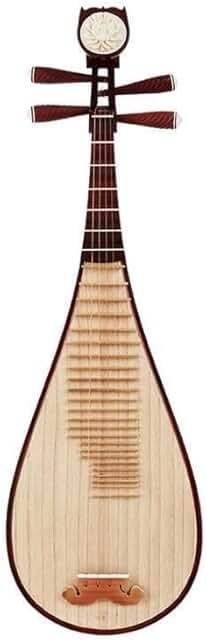
The
pipa is a four stringed lute with a pear-shaped body. Its short,
bent neck has 30 frets which extend onto the soundboard, offering
a wide range (3.5 octavos). This instrument appears in texts dating
up to the second century B.C. There are a lot of written texts of
the Han Dynasty (206 BC - 220 AD) about pipa music played and the
stories that inspired the composition for those pipa pieces. Since
the Tang Dynasty (618-907), the pipa is one of the most popular
Chinese instruments, and has maintained its appeal in solo as well
as chamber genres. The pipa technique is characterised by spectacular
finger dexterity and virtuosi programmatic effects. Rolls, slaps,
pizzicato, harmonics and noises are often combined into extensive
tone poems vividly describing famous battles or other exciting scenes.
The instrument is also capable of more lyrical effects in pieces
inspired by poetry, landscapes and historical themes. Pipa music
has been loved by Chinese people through centuries and there used
to be a large repertoire of pipa music, a lot of them were lost,
and some of them were handed down from generation to generation
through individual artists and scholars. |
Home|Musicians
|Instruments |Classes
|Calendar |Forum
|
|Shop |Music |CD
Album |Links |Contact
US |Site Map |
|